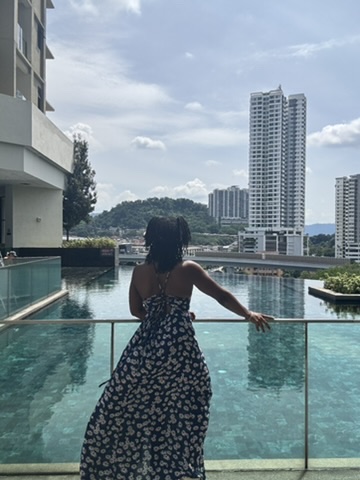
I’ve been in Thailand for about 2.5 months now. This journey has, indeed, been a journey — but a beautiful one nonetheless. I originally wrote a post that I felt properly captured my experience here, but I’ve decided not to share that one. Instead, I want to talk about my time in Thailand a little differently.
Thailand is the first Asian country I’ve ever visited. [I may have said that before.] My first week here was unforgettable.
I got lucky with Ghana being the first country I ever traveled to — the communication barriers weren’t the same there. In Ghana, English is often a second language [hard side-eye at the UK], so understanding people, the nuance, the flow — it came easier. Thailand? Completely different.
If I had to describe my first week here in one word, it would be: green. And never have I been that green before. Between letting the elevator door slam on a neighbor, flooding the basement while trying to get water, and constantly — constantly — losing my way (Miss Ma’am walked in a circle for 10 minutes straight, confused), I was humbled quick. The language barrier added to that.
Now, I know there are people who say you don’t need to learn the language when visiting a new country. But I promise, you do. Being able to speak with people in the way they communicate matters. Language is important to me. It always has been.
I remember in 4th grade, we had a new student join us from Mexico. The principal walked her in and said, “She doesn’t speak English. Does anyone speak Spanish?” — like we weren’t a bunch of 8-year-olds. But little me stood up proudly. I did speak a little Spanish. Enough to say “hello,” “thank you,” “please,” “bye,” and count to 30. I remember how good it felt to connect with her — even in that small way. I can only imagine how it felt for her. The teacher sat her next to me, so I could “help.” But I quickly realized: while she didn’t speak English, she could read and write it. A skill the adults around us hadn’t even tried to uncover.
Moments like that never left me.
Years later, in 6th grade, I attended a school that was 90% Hispanic/Latino. It was my first deep dive into a culture that wasn’t mine. I discovered pan dulce. Horchata. Selena (the CD, not JLo). I listened to families gathering, laughing, music pouring out of speakers in the morning (music my dad hated — but I loved). I soaked up everything I could. I even learned the “bad words” from my neighbor and classmates. I was curious, playful, and fascinated by how language shaped us.
One day I asked a classmate, “How does Spanish sound in your ear? Does it just, like, translate to English inside your head?” She chuckled — and explained how language works. That moment shifted something in me. It made me realize how vital language is. Why it’s always felt important for me to try speaking to people in their language. Why should mine be the default?
So as I grew older and began traveling, I’ve always been intentional about language. No further proof of that than with Ghana. My Twi is officially my second language now — I understand it better than I do Spanish. Speak to me in Twi, and I’ll catch it. My tongue is coming along, too. You can drop me in Makola and I’ll get around just fine without using English. [Chale, menyɛ obroni sika oo.]
So of course when I came to Thailand, I made it my mission to learn at least the basics. Thai is hard — like Twi — especially in pronunciation. My proper American-English tongue is my bane. But I’ve been trying. And with time, I’ve gotten better.
Now, after a little over two months, I can speak enough Thai that locals think I actually speak Thai. And when they hear me? They’re impressed. My Thai is far from perfect, but my “Khop khun ka” (thank you), and “Sawadee ka,” (hello), paired with “aroi” (delicious), “suay” (beautiful), “mai mi” (no), and “chai” (yes)… plus a sprinkle of “ka” at the end of everything… it gets me by.
The language barrier I faced in the beginning is barely there now.
Sometimes people ask me, “Why are you speaking Thai?” Ghanaians ask the same thing about Twi — “Your English is good, why stress?” To both I say:
- Every human deserves to be spoken to in their own language.
- Learning the language of a place you’re visiting is a sign of respect.
- I’m not a Westerner who believes everyone should conform to my understanding.
- I’m a child of the world — a student in your culture — and I’m here to learn.
I don’t know when people stopped caring about respecting their neighbors, but I know it’s deeply connected to capitalism. Definitely to colonialism. And it’s just another reason why so much of this world feels off.
Travel should be about more than stunning Instagram photos and “living your best life” in someone else’s backyard [though yes, take those photos]. It should be about listening. Learning. Showing up with humility and curiosity.
The best education I’ve ever received didn’t come from a classroom. It came from airports. Markets. Getting lost in alleyways.
“Word of mouth” is still the greatest teacher on earth.
And language — language is the mouth.
Also, let’s be real: sometimes speaking the language can save you money. Ever heard of foreigner price? Yeah. Speak the language, and suddenly that 200 baht tuk-tuk becomes 60.
So yes, I will always try to speak your language.
Because that’s what you do when you want to truly connect.
Because that’s how you show people they matter.
Because that’s how I honor the people — and places — who make this world worth traveling


 Authentically Christine
Leave a comment